All About Pick Numbers
Posted on 11/25/2025
By
PMG and Bank Note Reporter
Without a standardized numbering system, researching and organizing a paper money collection can be a frustrating experience. It can be a time-consuming process and prone to mistakes that industry professionals and collectors want to avoid.
One of the most popular and industry-preferred methods for addressing this challenge is Pick numbers. A Pick number is a globally recognized identifier assigned to an individual bank note and its issuing country. It begins with a “P” (or the word “Pick”) and is followed by a unique number assigned to the issue — for example, P-567. Sometimes, a letter is added if the note is from a series, such as P-567a, P-567b, if there is a specific signature combination or other attribute that distinguishes it from other notes in the series.
Pick numbers are a helpful organizational tool often used by collectors, dealers, auction houses, and grading companies. Two organizations that have been leading the way in Pick numbering are the third-party grading company Paper Money Guaranty (PMG), and Bank Note Reporter’s sister company, NumisMaster, which houses pricing, specification, and identification information for coins and paper currency.
 |
|
| The PMG certification label of this Singapore note shows its Pick catalog number beneath the word Singapore. To the right of that is a separate catalog number in a specialized reference work by Vincent Tan. Click image to enlarge. | |
Origins of Pick Numbers
Veteran collectors will recognize Pick numbers from the Standard Catalog of World Paper Money (SCWPM), which was a reference series created by noted German numismatist and inventor of the Pick numbering system, Albert Pick. Within each catalog listing of a bank note was a description and key details, such as a release date and signature combinations, all tied to an individual Pick number.
The SCWPM was published by Krause Publications, which is Bank Note Reporter’s former parent company. In 2019, Penguin Publishing acquired the publishing rights of SCWPM, while Bank Note Reporter’s present publisher, Active Interest Media (AIM), purchased the Pick number database.
Where to Use Pick Numbers
Following these changes, PMG began independently assigning new Pick numbers sequentially with the SCWPM numbering system. These numbers are attributed on the PMG certification labels, making it easy for collectors to instantly find this important information about notes that have been authenticated, graded, and encapsulated by PMG.
 |
|
| The PMG certification label of this 2019 series India note shows a catalog number of 114r. Click image to enlarge. | |
Concurrently, AIM launched NumisMaster with the Pick numbering data and introduced Standard Catalog (SC) numbers for newly issued and previously unnumbered notes. While SC numbers may appear distinct, they are fully aligned with the Pick numbering system and are interchangeable within NumisMaster.
Over the past year, PMG and NumisMaster have collaborated to create, maintain, and issue new Pick numbers. PMG’s website contains free resources, including a Population Report (PMGnotes.com/population-report) where users can explore each country’s currency. For each of these resources, the Pick numbers are essential to organizing the data. For instructions on how to use the PMG Population Report resource, click here.
This partnership ensures consistency across PMG’s labels and its online resources with NumisMaster’s listings and SC numbers. The Pick numbering service is free to access on both websites. NumisMaster also offers tiered subscriptions that unlock pricing data searchable by Pick number.
“We are pleased to collaborate with NumisMaster in supporting a paper money numbering system that makes things easy for the collectors who trust their notes to us,” said Adam Howerton, Vice President of PMG Grading. “This helps the entire paper money collecting hobby grow.”
For more information, visit NumisMaster.com and PMGnotes.com.
Using the PMG Population Report
 |
|
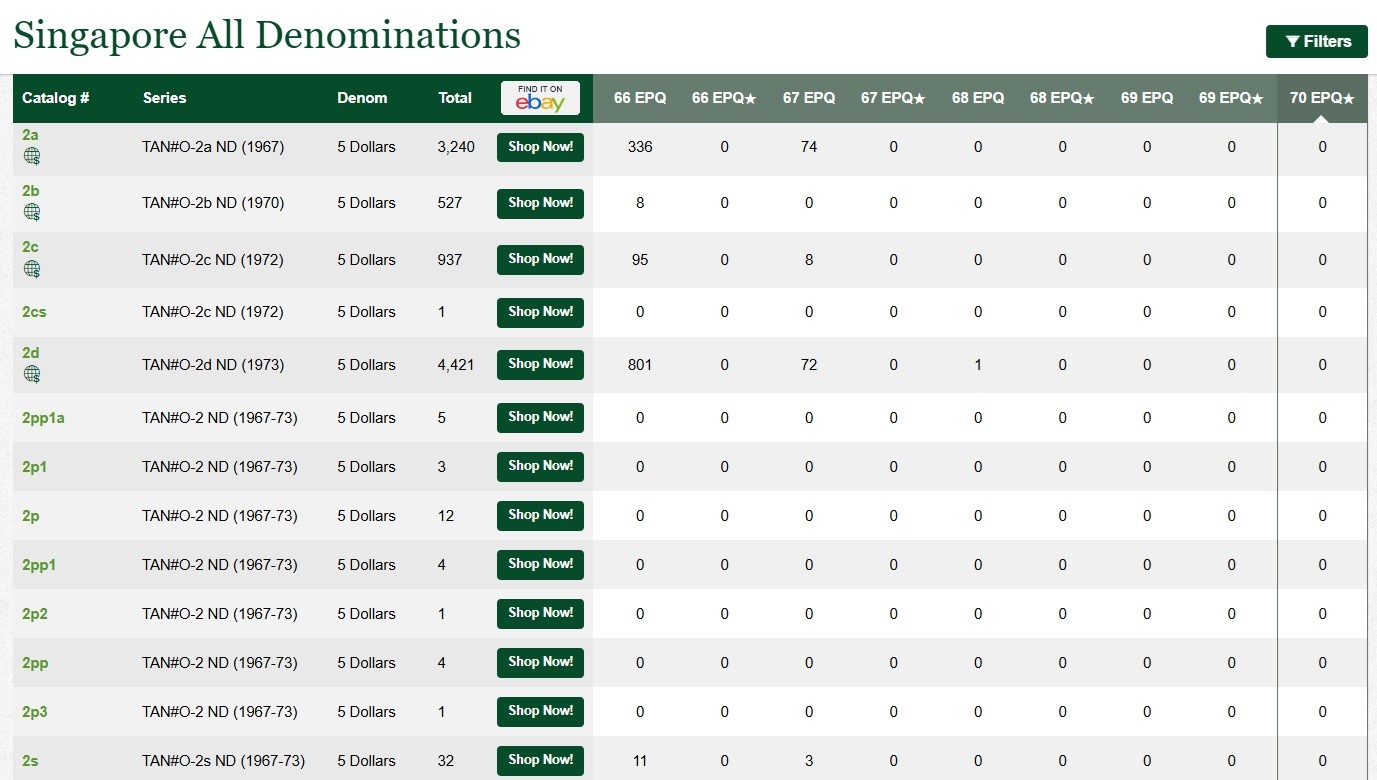
| A screenshot of the PMG Population Report, which shows the catalog number in the left columnClick image to enlarge. | |
- Go to PMGnotes.com.
- Click on the Resources menu, then select PMG Population Report.
- Place the cursor in the "Search for a specific note" search bar, and end the information you have about the note, such as the country, series and denomination. Click on an option that auto-populates to explore data for that country and denomination in the PMG Population Report.
- From the main PMG Population Report menu, you can also select a specific country by scrolling, and then select the denomination you wish to explore. If you wish to explore all the denominations, then select View All.
- To find the catalog number, look at the left hand of the table.